Documentation
Aide et manuel
Qui exploite un serveur chez soi veut savoir dans quoi il s’engage. C’est pourquoi tout est accessible librement — sans compte, sans inscription.
Bienvenue dans l'aide centrale d'AnnexGroup. Les documents qui se trouvent ici s'adressent aussi bien aux utilisateurs qu'aux administrateurs et aux développeurs, et sont mis à jour à chaque version.
Démarrage rapide
- Installation
- Premiers pas après l'installation
- Tableau de bord et supervision
- Boîtes courriel et dossiers
- Agenda et iMIP
- Contacts, calendriers et tâches
Administration
- Gestion des utilisateurs et des domaines
- Assistant de configuration (admin-wizard)
- Paramètres de sécurité
- Sauvegardes et restauration
- Migration Exchange
- Archivage et RGPD
- Règles de transport
- Conformité et eDiscovery
- Gestion des licences
Pour les développeurs
Un sujet manque ? Signalez-le via la page d'administration ou auprès de votre contact.
Démarrage rapide
Agenda et iMIP
AnnexGroup offre plusieurs agendas par utilisateur. Les rendez-vous se gèrent via CalDAV ou l'interface web. Créer, renommer et supprimer des agendas Sur la p…
Boîtes courriel
Chaque utilisateur possède une boîte courriel personnelle avec des dossiers standards. Via l'interface web, vous pouvez lire, rédiger, déplacer, supprimer e…
Contacts, calendriers et tâches
Outre le courriel, AnnexGroup offre une gestion centralisée des contacts, des rendez-vous et des tâches. Contacts Saisie manuelle ou import par vCard. Export …
Installation
Cette page vous mène du fichier téléchargé au service en fonction. Ensuite, continuez avec Premiers pas. Prévoyez une demi-heure, si la base de données et…
Premiers pas
Après l'installation d'AnnexGroup, configurez le premier domaine et le compte administrateur via l'assistant de configuration. Étape 1 : configuration initial…
Tableau de bord et supervision
Le tableau de bord vous montre en un coup d'œil l'état actuel du serveur et de votre communication. Widgets CPU / mémoire / disque : utilisation sous forme d…
Administration
Archivage et RGPD
AnnexGroup offre des fonctions techniques pour un traitement des données conforme au RGPD. Archivage Archivage automatique selon les durées de conservation D�…
Assistant de configuration (admin-wizard)
L'assistant de configuration sous /admin/wizard vous guide pas à pas dans les tâches de configuration récurrentes. Il est particulièrement utile après la p…
Conformité et eDiscovery
AnnexGroup offre des fonctions de conformité côté serveur pour l'administration quotidienne : blocages légaux, recherche eDiscovery, journalisation et modè…
Gestion des licences
AnnexGroup utilise une gestion de licences locale sans phone-home. La licence est stockée sur le serveur et validée avec une clé publique Ed25519. Licence d'…
Gestion des utilisateurs et des domaines
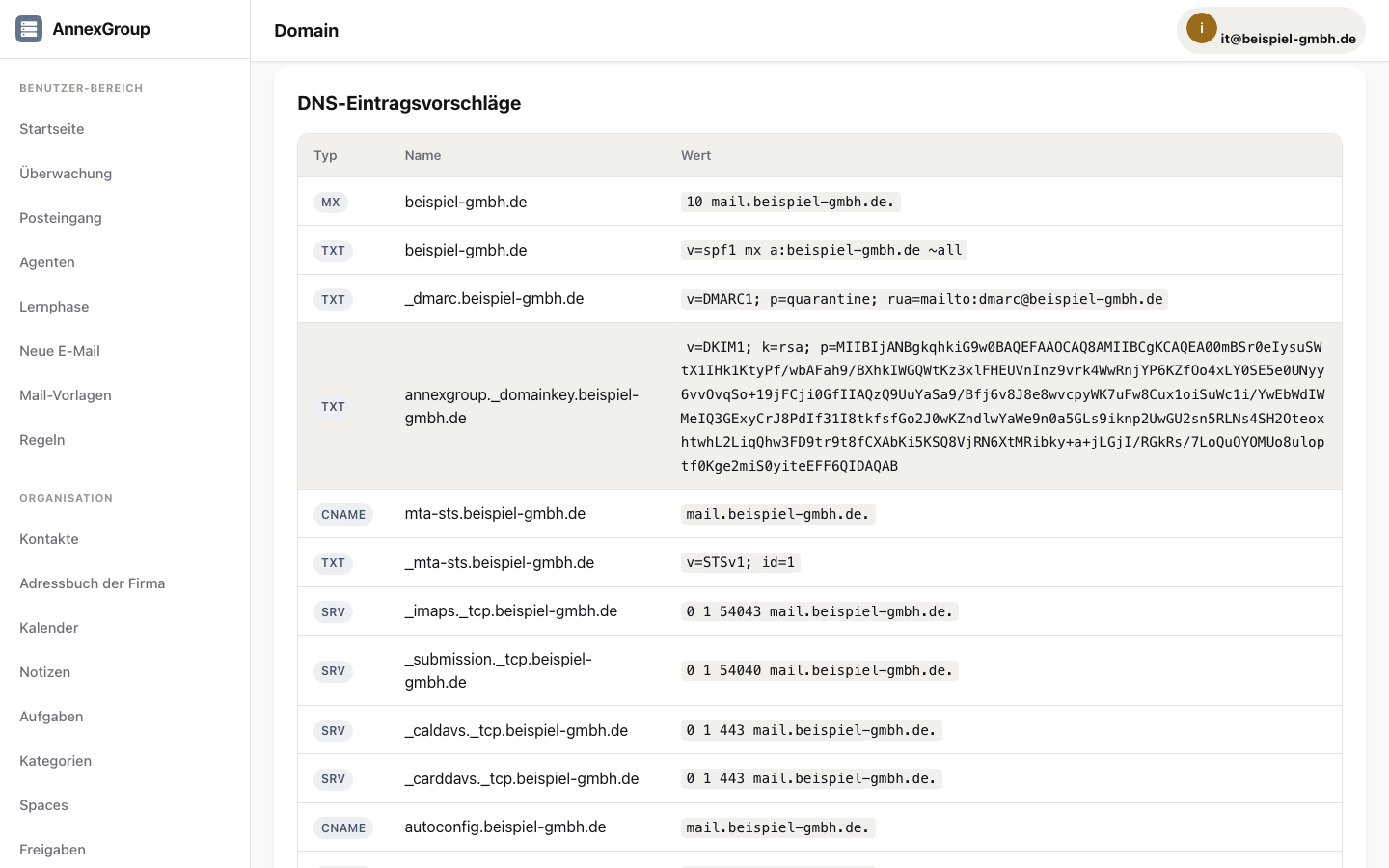
L'administration est accessible sous /admin. Domaines Chaque domaine nécessite : un enregistrement MX valide une entrée SPF une clé DKIM (générée dans Ann…
Migration depuis Exchange
Le serveur AnnexGroup reprend les données de Microsoft Exchange et d'Outlook lui-même — en règle générale en une seule passe, sans Mac interposé. AnnexO…
Paramètres de sécurité
Sous Administration → Sécurité, vous configurez le profil de sécurité du serveur. Profils de sécurité Équilibré : réglages équilibrés pour l'exploi…
Règles de transport
Les règles de transport permettent aux administrateurs de modifier les courriels entrants et sortants côté serveur, avant leur remise ou leur mise en file d'…
Sauvegardes et restauration
Sous Administration → Sauvegarde et restauration, vous créez et gérez les sauvegardes. Ce qui est sauvegardé base de données MySQL/MariaDB stockage des bl…
Pour les développeurs
Protocole AnnexTalk
AnnexTalk est le protocole wire ouvert pour les agents, les espaces et la communication en temps réel dans AnnexGroup. Points d'API URL de base : /api/v1/annex…
Vue d'ensemble de l'API et d'OAuth
AnnexGroup fournit une API REST sous /api/v1/. Authentification Cookie de session : pour les requêtes de l'interface web OAuth 2.0 : pour les applications tier…
Par où commencer
Vous voulez essayer
Premiers pas → Assistant d’administration. Comptez une à deux heures, dont l’essentiel à attendre le DNS.
Vous voulez remplacer Exchange
D’abord ce qu’AnnexGroup couvre et ce qu’il ne couvre pas, puis la migration. Dans cet ordre — cela peut vous épargner l’installation.
Ça tourne et ça bloque
Surveillance et Sécurité couvrent les cas fréquents. Si l'interface web n'est plus accessible, annexgroup restore-backup restaure une sauvegarde — prouvé pour la même machine et la même base de données, et sur une machine différente avec une base de données vide ; le comptage concordait. Si rien n'y fait : écrivez-nous.
Quelque chose manque ou est mal décrit ? Dites-le-nous. Votre question nous montre où le texte est insuffisant — et c’est la seule manière fiable de le savoir.